Care
How to look after it.
Four short guides, by material. Every part also carries its own care instructions in the record on its product page, and a printed card repeating them ships in the box.
Plated & stainless fasteners
Two different materials with two different weaknesses. Zinc-plated steel is strong and cheap and rusts once the plating is breached; stainless resists corrosion properly and galls if you drive it carelessly.
Do
- Keep plated fasteners dry. The zinc is a sacrificial coating, not a rust-proof one.
- A light wipe of machine oil on threads before storing extends their life considerably in a damp shop.
- Drive stainless slowly, and use an anti-seize compound in any stainless-into-stainless thread — especially M8 and above.
- Seat a hex key or driver fully before applying torque. A partly seated tool is what rounds a socket.
- Chase a damaged thread with a die rather than forcing a nut over it.
Do not
- Do not use zinc-plated fasteners outdoors or anywhere damp. They bloom white and then rust within a season — use the stainless.
- Do not drive stainless fast and dry. It cold-welds, seizes halfway in, and then only comes out with a drill.
- Do not put stainless in direct contact with aluminium in a wet environment without isolating them — the galvanic pair eats the aluminium.
- Do not reuse a split lock washer once it has been compressed and removed. It has lost most of its spring.
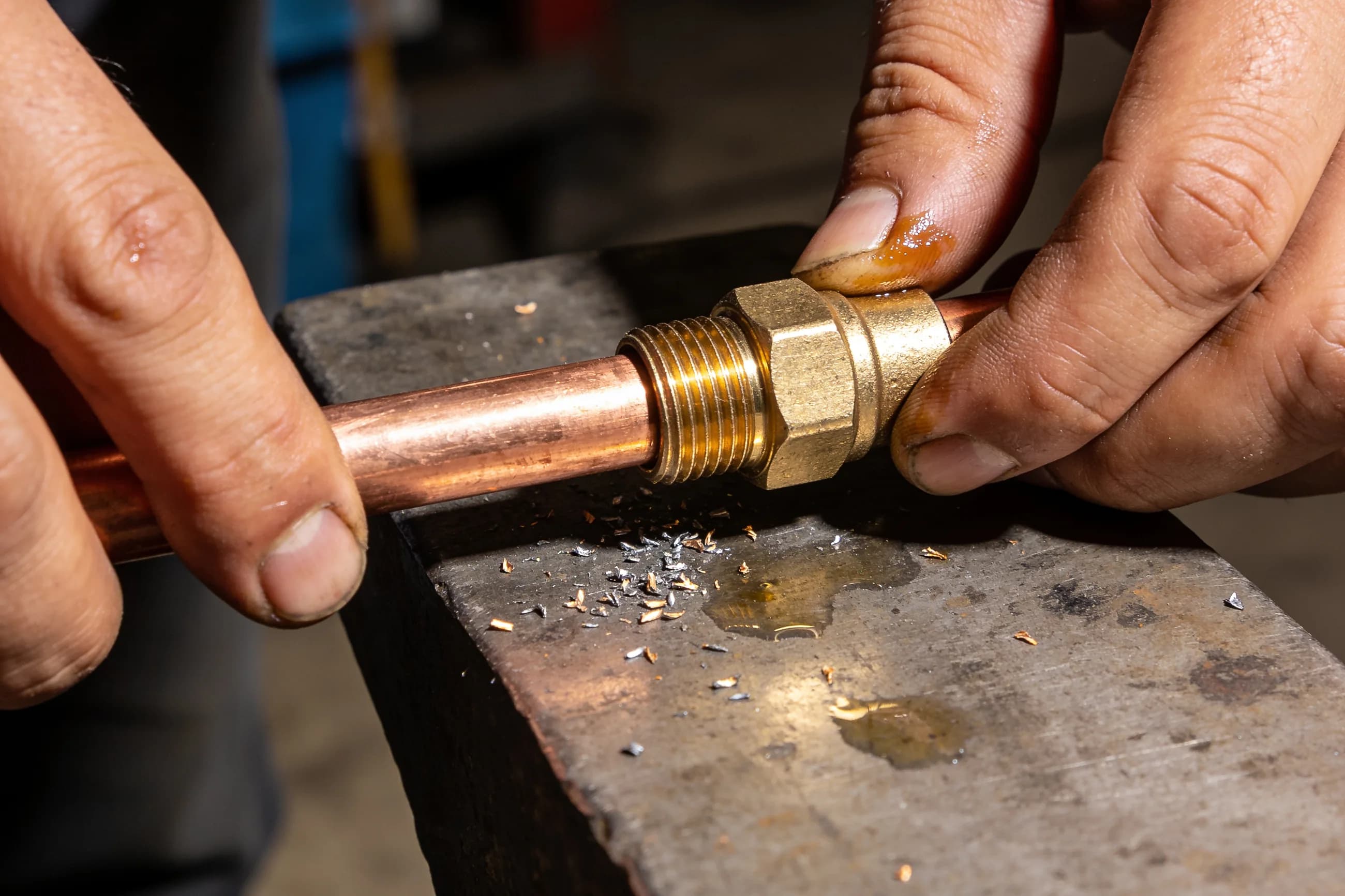
Unlacquered brass
Machined from solid bar and left unlacquered, so it arrives bright and goes brown. That is the material behaving exactly as intended and it cannot be prevented without lacquering it, which would then chip.
Do
- Wipe with a dry cloth and let the patina develop. It evens out over a few months.
- Cut pipe square and de-burr the inside before making a compression joint — a burr scores the olive and the joint weeps.
- Tighten a compression fitting until resistance rises sharply, then a quarter turn. No further.
- Use a new olive on every remake. A crushed olive does not seal twice.
- PTFE tape on pipe threads, three or four turns clockwise — never on a machined seat face.
Do not
- Do not polish it back unless you intend to keep polishing it. It is a job with no end.
- Do not put a pipe wrench on a union body. It deforms the hex and the seat together.
- Do not mix our olives and nuts with another manufacturer's — the taper angles differ and it will not seal.
- Do not drive brass wood screws without a pilot hole. Brass shears, and then you are drilling the head out.
- Keep brass away from untreated oak and western red cedar in damp conditions — the tannins corrode it and stain the timber black.
Forged tools & cast iron
Forged steel is tough and warns you before it fails. Cast iron is rigid and does not warn you at all. Almost every caution below follows from that difference.
Do
- Wipe tools dry after use. Chrome plate resists rust well; the exposed steel at a chipped edge does not.
- Pull a wrench rather than pushing it — a slipping wrench you are pushing puts your knuckles into the work.
- Keep an adjustable spanner's worm screw clean and lightly oiled, and re-check the jaw as you work; it can walk open under load.
- Keep the vice slide and screw clean and greased, and wipe the bright machined faces with an oiled rag.
- Bolt a vice down through all three holes. Two bolts flexes the casting every time you load it.
Do not
- Never hit a wrench with a hammer or extend it with a pipe. Both are how a hardened tool cracks, and it cracks suddenly.
- Never hammer on a vice. Cast iron cracks rather than bending, and a cracked vice can fail under load.
- Do not use a wrench or spanner on live electrical work. None of these tools are insulated.
- Do not put an adjustable spanner on a rounded or seized fastener — it finishes the job of destroying it.
- Do not clamp hot work in the vice. The heat destroys the temper of the jaw plates.
Leather & waxed canvas
Both are finished with oils or wax rather than sealed, which is why they age well and why the wrong cleaning product ruins them permanently.
Do
- Wipe leather with a dry cloth. Let mud dry, then brush it off.
- Re-oil leather once or twice a year with a neutral conditioner when it looks dry or pale at the folds.
- Roll a tool roll rather than folding it — a crease in oil-tanned leather is permanent.
- Brush canvas dirt off dry; for anything worse, cold water and a stiff brush only.
- Re-wax the high-wear areas of a canvas bag once a year, warmed in.
- Empty a bag before storing it. Tools left in for a season leave rust marks in the canvas.
Do not
- Never machine wash, tumble dry or dry clean waxed canvas. All three strip the wax and it cannot be fully restored.
- Never dry leather near a heater, a radiator or in direct sun. It goes hard and cracks and does not come back.
- No saddle soap, detergent or solvent on oil-tanned leather — all three strip the tanning oils.
- Do not set a waxed bag on light upholstery or a car seat you care about. The wax transfers, particularly in warm weather.
If something has gone wrong anyway
Anything that arrives damaged, short or wrong is replaced or refunded in full — email us within 14 days. See returns and refunds.
help@olympexsupply.com — Monday–Friday, 7:00am–4:00pm ET. Every message answered within one business day.